
Rollercoaster thriller about the crime that shook Belgium
Goran Jovanović
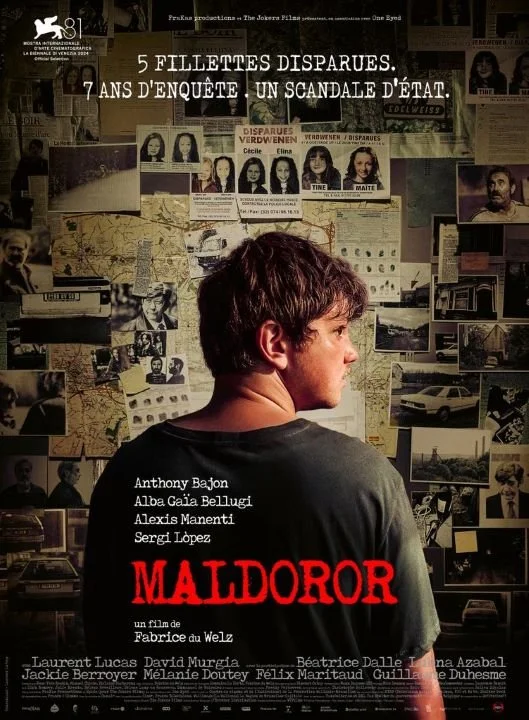
Maldoror, a film by the seasoned Belgian master of the genre Fabrice Du Welz, offers a deftly directed and gripping two-and-a-half-hour story inspired by events in Belgium in the 1990s. It was a major judicial scandal centered on Marc Dutroux, a serial killer and child molester. At the heart of the narrative is an investigation into the disappearance of girls abducted by Marcel Dedieu (fictionalized Dutroux). The investigation essentially falls on the shoulders of a young police officer Paul Chartier, a member of the gendarmerie, who, in parallel with business challenges, makes strides in his personal life as well.
By following the undoubtedly brave and talented police officer, who with almost every move shows a penchant for truth and justice, the film talks about the numerous obstacles that come due to the vague, controversial powers and conflicted jurisdictions of three police forces: the local police, the judicial police and the gendarmerie. The protagonist’s attitude is quite different from that of his superior, whose orders tend to hinder rather than advance the investigation, while his colleagues are mostly cautious and indecisive. As a counter to the investigative dead-end that everyone seems to gravitate toward for some reason, the film introduces a noble outsider—a rebel detached from the corrupt mechanisms in which the police and judiciary are mired, a defiant individual just beginning to spread the wings of his defiance.
The filmmaker employs an impressive range of genre tools to maintain the tension of his thriller, and his considerable cinephile experience allows him to send more discerning viewers both overt and coded tributes to the directors who shaped him or proved influential for this story (Francis Ford Coppola, Jonathan Demme, Christopher Nolan, Mathieu Kassovitz, Peter Jackson, Lenny Abrahamson). Introducing this chain of role models is still just a stylistic ornament, while the turbulent social and political context of Belgian society from the mid-90s to the first years of this century was far more challenging. This context, although cluttered with administrative-bureaucratic details, confusing competencies of institutions and tangled, is still fairly correctly brought to light. We will use the paraphrase of the already worn-out term "deep state", so in terms of abuse, manipulation and corruption, or because of a secret network of power, we could name all of this "deep institutions": through officials who do everything wrong, both because of big money and because of careerism.
We have not recently seen so much affection from one author for his hero, as Fabrice Du Welz expressed towards the young and brave police officer from the secret unit "Maldoror". As the pitfalls, challenges and temptations become bigger, along with the layers of experience, basic instinct and fanatical perseverance, the protagonist turns into a seasoned wolf before our eyes, carried by remorse and vengeful anger. To make this character so powerful, Du Welz has weighed him down with an unprecedented burden: tons and tons of moral conflict and psychological decline. Obsessed with the case of the girls, he almost opens the door to madness because, although shaken, he never fully opened the right one while the children were still alive.
Maldoror is a powerful and convincing, production-wise ambitious genre story that confidently guides us through the labyrinths of crime and lawlessness. Du Welz pointedly underscores how corruption and deliberate inaction within institutions allow the most depraved individuals to engage in pedophilia, the distribution of child pornography, and brutal murders with impunity.